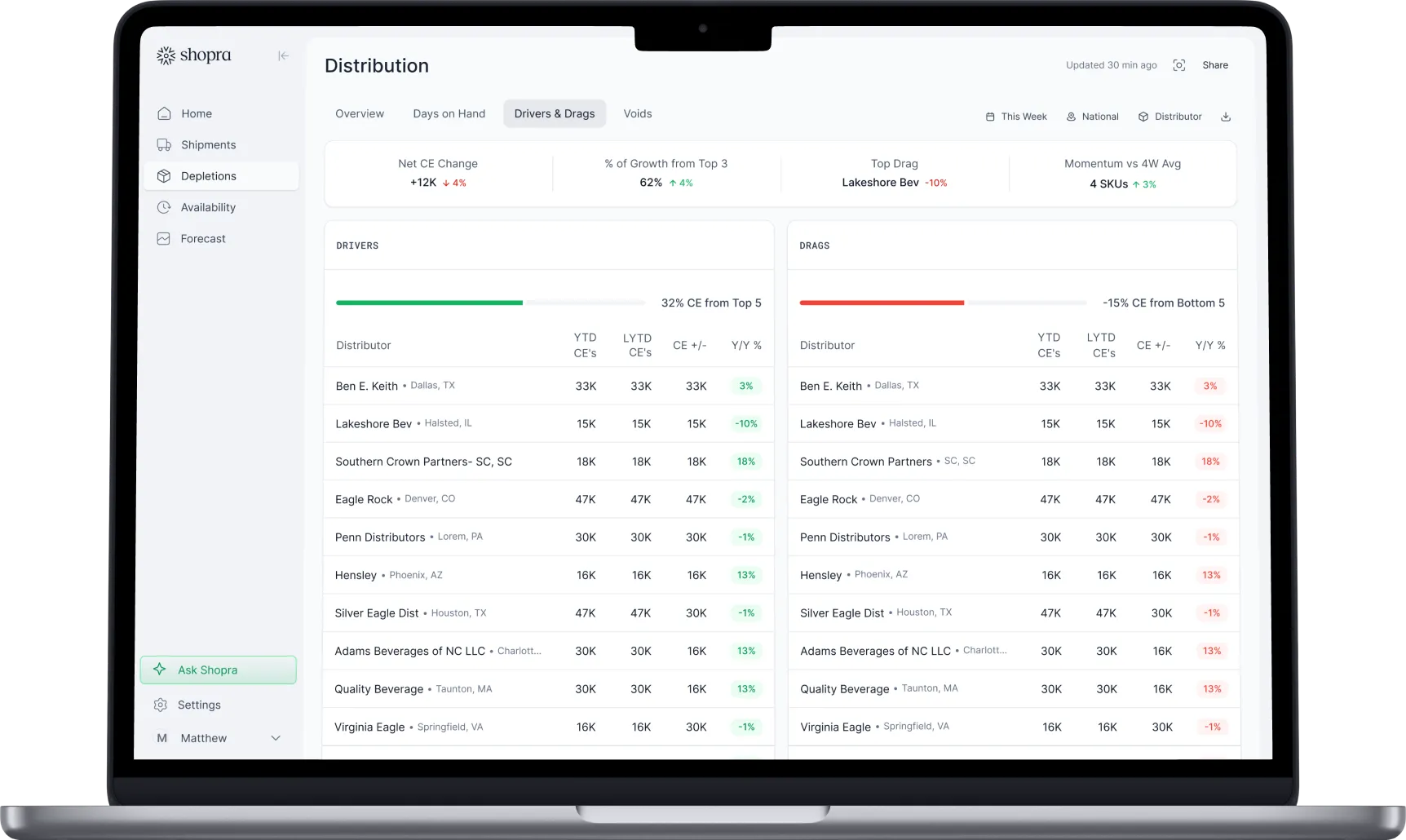
Three-tier analytics
See every tier of the three-tier system in one view
Shopra connects shipments, depletions, and retail scan so you can see how each tier affects the next, and where performance is slipping.
What is three-tier analytics?
Three-tier analytics is reporting that connects all three tiers of the U.S. beverage system: suppliers sell to distributors, distributors sell to retailers, and retailers sell to consumers. Because each tier keeps its own data in its own systems, most brands see each tier separately and miss how the tiers affect each other.
What is the three-tier system?
The three-tier system is the structure for selling alcohol in the United States that states adopted after Prohibition ended in 1933. Producers, distributors, and retailers are kept as separate businesses. Many non-alcoholic beverage brands sell through the same distributor networks, so they face the same data split.
What data exists at each tier?
| Tier | Transaction | Typical data source | Key measure |
|---|---|---|---|
| Supplier | Sells to distributor | Your ERP, such as NetSuite or SAP | Shipments |
| Distributor | Sells to retailer | VIP or Encompass | Depletions, inventory |
| Retailer | Sells to shopper | Circana, SPINS, NielsenIQ, retailer portals | Scan sales, in-stock |
Why is it hard to see the tiers together?
- Each tier uses different systems, product codes, and account names.
- Units differ, so volume has to be converted to case equivalents.
- Data arrives on different schedules, from daily to weekly to monthly.
- No shared ID links a shipment to the depletion and the scan it becomes.
How do you read the three tiers together?
Over a few months, shipments, depletions, and scan should converge. When they diverge, the pattern points to the cause:
| Pattern | What it usually means |
|---|---|
| Shipments well above depletions | Distributor inventory is building |
| Depletions well above scan for weeks | Product is reaching stores but not selling, a velocity problem |
| Scan steady but depletions falling | Retail inventory or distribution is at risk |
| Scanning stores declining week after week | Distribution is eroding, often after out-of-stocks |
How does Shopra connect the three tiers?
Shopra plugs into your ERP, distributor data from VIP and Encompass, and retail scan feeds, harmonizes products, units, and accounts, and shows all three tiers in one model. You see where performance is off plan and which tier explains it, with the drill-down behind every number.
Frequently asked questions
Does the three-tier system apply to non-alcoholic beverages?
The legal requirement applies to alcohol. Many non-alcoholic brands still sell through the same beer and beverage distributors, so their data is split across the same three tiers.
What is the difference between sell-in and sell-through?
Sell-in is what you ship to distributors. Sell-through is what moves on to retailers and then to shoppers. Healthy growth needs both to rise together.
How long does it take for the tiers to line up?
Usually a few months. New items and promotions load distributors first, so short-term gaps are normal. Gaps that persist beyond a quarter deserve a closer look.
What systems does Shopra connect to?
ERPs like NetSuite and SAP, distributor platforms including VIP and Encompass, retailer portals like Walmart, Kroger, and Target, and scan data providers including Circana, SPINS, and NielsenIQ.
Integrations
Connect the sources you already run on.
Shipments, depletions, distributor inventory, and retail scan flow in through a mix of near real-time integrations and 24-hour SFTP exports and ingestion, including VIP and Encompass, plus API access and a fast agent backend for querying.


Your data stays yours. Enterprise plans can run on a dedicated Google Cloud warehouse you own.
ready when you are
Turn your data into your next move
See your drivers, your drags, and where to act today.
Get a demo