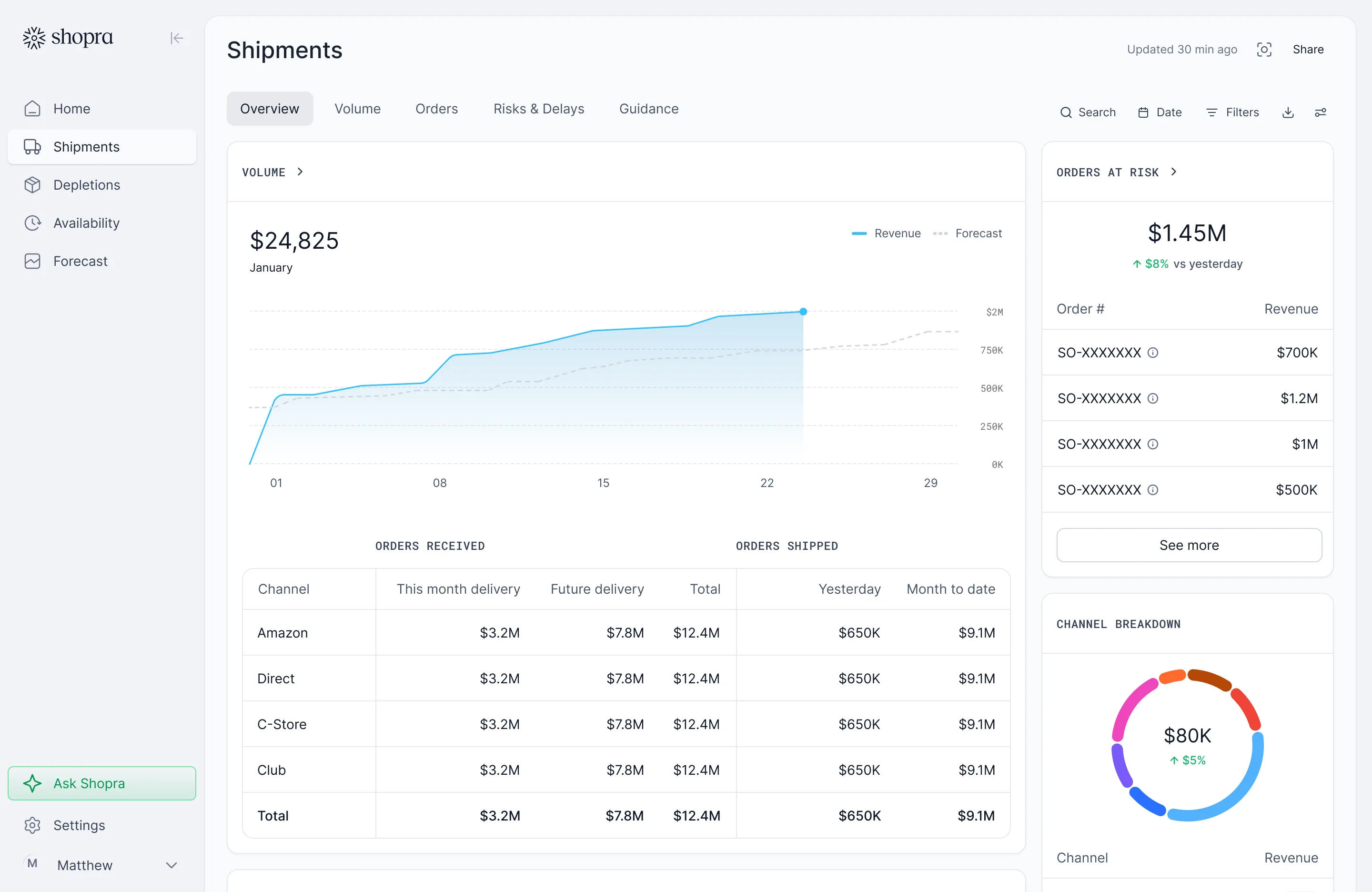
Forecast variance
Here's what's off plan. Here's why.
Shopra shows where performance diverged from forecast and whether distribution, velocity, or promotions explain it, with the evidence one click away.
What is forecast variance in beverage?
Forecast variance is the gap between what a beverage brand planned to sell and what it actually sold, measured in shipments, depletions, or scan. Knowing the size of the gap is easy. Explaining it, and deciding whether to change the forecast, the supply plan, or the commercial plan, is the hard part.
What causes a forecast miss?
Most beverage misses fall into three groups. Working through them in order separates a supply problem from a demand problem:
| Cause | Examples | Where the evidence lives |
|---|---|---|
| Distribution | Missing doors, lost PODs, out-of-stocks, delayed or short shipments | Distributor depletions and inventory, retailer in-stock, your shipments |
| Velocity | Category slowdown, one SKU or one retailer declining, price changes | Retail scan and depletions per point of distribution |
| Promotions | Promotion not executed, lift below plan, timing shifted between periods | Trade promotion plans, scan during the promotion window |
How do you investigate a forecast miss?
- Locate the gap: which SKUs, distributors, retailers, and weeks account for most of it.
- Check availability first: were stores and distributors in stock? An out-of-stock looks like weak demand.
- Check distribution: did the item lose PODs or miss planned new doors?
- Check velocity: are sales per point of distribution down, and is it the category, the SKU, or one retailer?
- Check promotions: did planned promotions run, on time, with the expected lift?
- Decide the action: adjust the forecast, fix supply, or change the commercial plan.
Why is variance analysis slow today?
- Shipments, depletions, scan, and promotion plans live in different systems with different product codes.
- Each question means a new export and a new spreadsheet.
- By the time the analysis is ready, the next forecast cycle has started.
How does Shopra explain forecast variance?
Shopra joins your shipments, distributor depletions and inventory, retail scan, and promotions into one model, then walks each miss through distribution, velocity, and promotions. Demand planners see what is off plan, the likely cause, and the drill-down behind it every morning. Shopra explains variance against your forecast; it does not replace your forecasting tool.
Frequently asked questions
Is Shopra a forecasting tool?
No. Shopra compares actuals with the forecast you already produce and explains the difference. Your forecasting process and tools stay in place.
Should variance be measured on shipments, depletions, or scan?
All three, because they answer different questions. Shipment variance drives supply decisions, depletion variance shows distributor demand, and scan variance shows consumer demand.
How do out-of-stocks affect forecast accuracy?
They make demand look lower than it is. Sales lost to an empty shelf should be treated as a supply problem, not used to lower the forecast.
How often should forecast variance be reviewed?
Weekly at minimum. A miss found during the month can still be acted on; one found after close can only be explained.
Integrations
Connect the sources you already run on.
Shipments, depletions, distributor inventory, and retail scan flow in through a mix of near real-time integrations and 24-hour SFTP exports and ingestion, including VIP and Encompass, plus API access and a fast agent backend for querying.


Your data stays yours. Enterprise plans can run on a dedicated Google Cloud warehouse you own.
ready when you are
Turn your data into your next move
See your drivers, your drags, and where to act today.
Get a demo