HubSpot for beverage
HubSpot for beverage brands: where it fits and where it breaks
HubSpot is a strong general CRM. Beverage account management runs on depletions, distributor inventory and scans, which HubSpot does not model. Here is how to tell which one you need.
Can you use HubSpot for a beverage brand?
Yes, for part of the job. HubSpot handles contacts, email, deal pipelines and marketing well, and it works for managing relationships with distributor reps, chain buyers and brokers. Where it falls short is the work that decides whether you hit plan: knowing each account's case forecast, whether the distributor has inventory, whether the product is scanning, and who to call when it is not. HubSpot has no built-in model for depletions, distributor on-hand or retail scan, so that data ends up somewhere else, usually in spreadsheets.
The short version: HubSpot is enough if your main need is contacts, email and a pipeline for new distribution. If your team spends its week asking which accounts are off plan and why, you need a CRM built on sell-through data.
What does HubSpot do well for beverage teams?
- Relationships: contact and company records for distributor reps, chain buyers and brokers.
- Outreach: email, sequences and marketing campaigns.
- New distribution: deal pipelines for chain authorizations and new distributor sign-ups.
- Getting started: a free tier and a large app marketplace.
Where does HubSpot break for beverage?
- Revenue is a case forecast, not a deal. Once a retailer authorizes your item, revenue comes from reorders through a distributor, week after week. A deal with an amount and a close date has nowhere to put that.
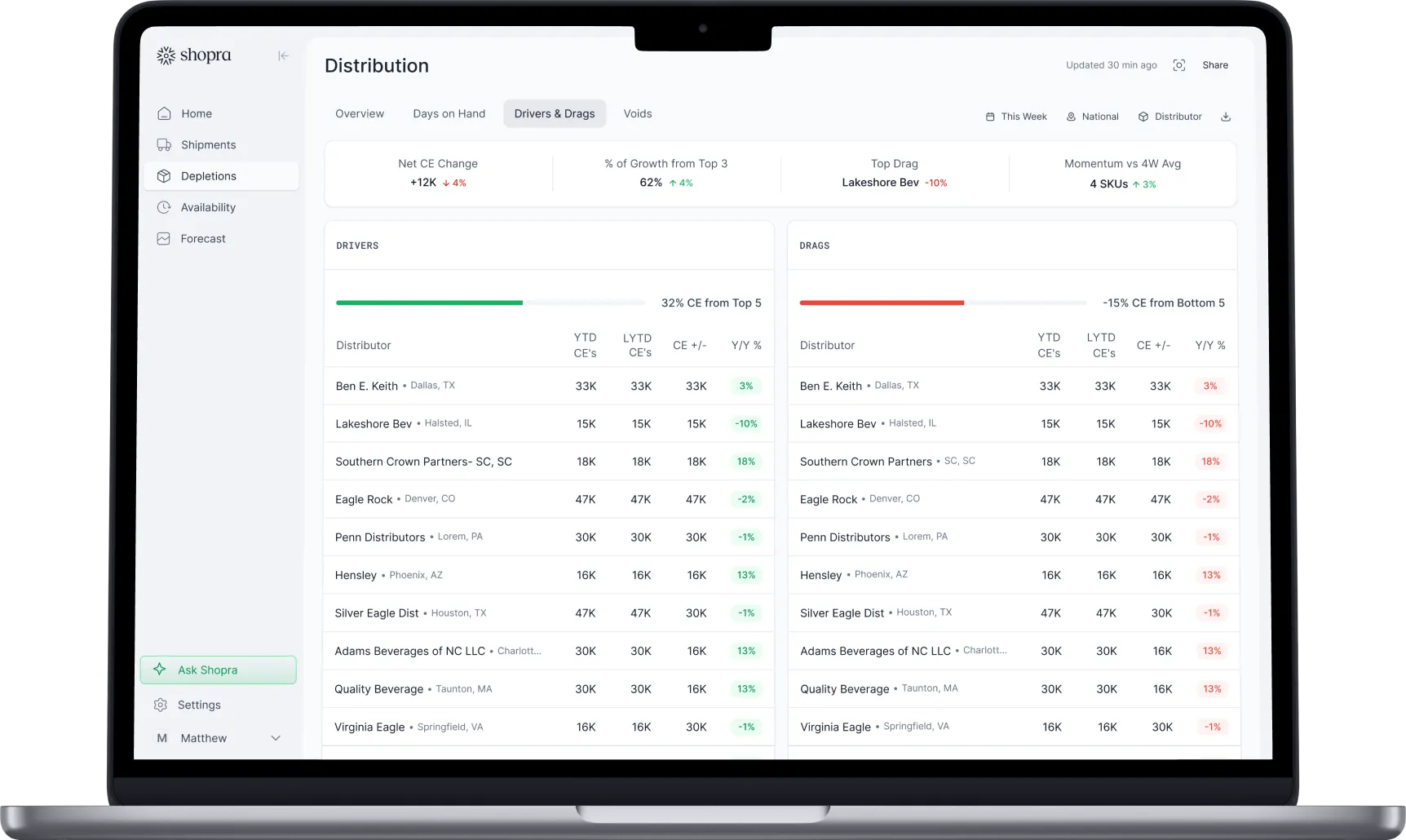
- No depletion data. VIP and Encompass depletions do not map to HubSpot records out of the box. Getting them in means custom objects, custom properties and an import or integration someone has to build and maintain.
- The three tiers do not fit. Your customer is the distributor, the account you manage is the retailer, and the shopper buys at the shelf. A contact, company and deal model has no standard way to link a store, its distributor and its scan data.
- Units and products do not line up. Case equivalence, distributor item codes and retailer UPCs all need mapping before any number adds up.
- No early warning. HubSpot cannot tell you that a distributor is down to four days on hand, or that scans dropped after a reset, because it never sees that data.
HubSpot vs a beverage CRM
| HubSpot | Shopra | |
|---|---|---|
| Built for | Any B2B sales and marketing team | Beverage brands selling through distributors |
| What an account plan is | A deal amount and close date | A case forecast by account, SKU and month |
| Depletions and distributor inventory | Custom build or CSV imports | Built in, from VIP and Encompass |
| Retail scan | Custom build | Built in, from scan providers and retailer portals |
| Alerts when an account slips | On CRM activity | On depletions, on-hand, deliveries and scans |
| Email and marketing campaigns | Strong | Drafts account outreach; not a marketing suite |
| Cost to start | Free tier | From $29/month |
When is HubSpot enough?
- You are early and mostly selling into new distributors and chains.
- You work with a few distributors and review sell-through monthly.
- Marketing email and lead capture are the main job.
When do you need a beverage CRM?
- Account managers spend hours a week in spreadsheets to answer whether an account is on plan.
- You find out about out-of-stocks or a distributor running low after the month closes.
- Your plan is built in cases by account and SKU, and nothing in your CRM shows it.
Can you use HubSpot and Shopra together?
Yes. You can keep HubSpot for contacts, email and your new-distribution pipeline, and use Shopra for account plans and sell-through: depletions, distributor on-hand, deliveries and scans against plan, with alerts and drafted outreach when an account slips. HubSpot does not need to hold your depletion data, and Shopra does not replace your marketing email.
Frequently asked questions
Is HubSpot a good CRM for beverage brands?
It is a good general CRM. It does not model depletions, distributor inventory or retail scan, which is where most beverage account management happens, so beverage teams usually pair it with spreadsheets or a beverage-specific tool.
What is a beverage CRM?
A CRM built around how beverage brands sell: through distributors, to retail accounts, measured in cases. It tracks each account's plan against depletions, distributor inventory, deliveries and scans, and flags who to call when an account slips.
Does Shopra replace HubSpot?
Not necessarily. Shopra is not an email marketing tool. It replaces the spreadsheets behind account plans and sell-through tracking. Some teams use it as their account management system; others keep HubSpot for contacts and email alongside it.
How fast can I see my own accounts in Shopra?
Send one VIP, Encompass or NetSuite export and you can see your shipments against depletions by distributor within 24 hours of the file landing, with no integration project.
Is Shopra affiliated with HubSpot?
No. HubSpot is a trademark of HubSpot, Inc. Shopra is an independent company, and this page is our own comparison.
Integrations
Connect the sources you already run on.
Shipments, depletions, distributor inventory, and retail scan load every day through SFTP exports and direct connections, including VIP and Encompass.


Your data stays yours. Enterprise plans can run on a dedicated Google Cloud warehouse you own.
ready when you are
Turn your data into your next move
See your drivers, your drags, and where to act today.
Get a demo